Showjumping Exercises to Improve Your Landing Position | Chris Bartle

Sep 28

Advice and exercises from Great Britain’s World Class Performance Coach Chris Bartle for you to try at home. In part two, we look at improving the landing position.

“Keep your upper body upright. Achieving a good landing position depends on establishing the correct position on take-off and in the air. The knee should be open and relaxed – not pinched in – so that the weight flows down into your heel. Concentrate on keeping your upper body, your head and your eyes up. Your lower leg should be strong and not swing back on landing. Most mistakes happen when the rider’s body gets in front of the upward curve and the horse has the front rail of the oxer down with his front or hind legs. I refer to the horse’s neck as its balancing pole. It doesn’t take much to tip the balance, so it is important that we sit in the centre of the horse and give him freedom to use his neck.”

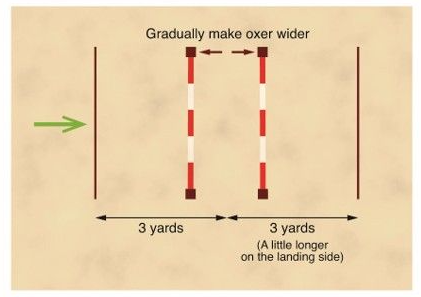
Exercise

  • Set up a low oxer with placing poles on take-off and landing three yards away from the centre of the fence (the apex of the horse’s bascule). Make the distance on the landing side slightly longer. 
  • Approach in canter and gradually make the fence wider (not higher). This will help develop the horse’s shape in the air (and make the rider work harder to stay in balance).

Ever wondered what stretches to do?

You'll be there new best friend - it involves carrots!

Understanding Fatigue

Prioritising your horse, even the best-conditioned horses can experience fatigue

Do you wonder how horses learn?

No need, we have the answer- learn from Gemma Pearson.

Don’t forget the warm-up:


  • Relaxation – “The more you can give the rein to encourage the horse to take his nose out, the better, and keep your seat light in the beginning to encourage him to relax and use his back.”   ·       
  • Control of direction – “The inside and outside reins have different jobs. The outside rein is the disciplining rein, whereas the inside rein is more giving – I sometimes call it the horse’s friend. Support them with your inside leg and wait for them to accept the outside rein, then they will start to drop the neck and relax the muscles, and you can allow the neck to straighten.”

Also in the series:

Accuracy on a Line

Improve Straightness and Control Drift

How to Ride the ‘What If’ Position

Improve Accuracy at Corners

Ready to take the next step?

Whether you're preparing for your first event or looking to build on your experience, BE Prepared gives you free access to expert coaching videos, practical guides, downloadable checklists and event-day advice to help you train smarter and compete with confidence.