
Soaking is one of the best ways to reduce the calorie content of your horse’s forage so it’s frustrating if they turn their nose up at it. Remember, you’re soaking the hay to wash out sugars (and calories), which taste sweet, so increase the soak time gradually to let their palate adjust – if you were trying to cut out sugar in your tea or coffee, you’d do it gradually and the same applies to the horse. This also allows the horse’s gut bacteria to adapt too. Here are some ideas for encouraging your fussy eater:
- Start with just 10 minutes time, if necessary, and build up very slowly, until you reach the 8 -9 hours. If you’re not around, you might have to ask someone else to remove the hay from the soaking container and store it somewhere cool, out of the sun, until you can feed it.
- Start off by mixing a small amount of soaked hay with unsoaked, or some that’s been soaked for a longer time with a portion that’s been soaked for a shorter time, and gradually increase the proportion of longer-soaked hay.
- When hay has been soaked for longer periods, rinsing it with clean water will help “freshen it up” and make it smell more palatable.
- Try spraying your soaked hay with cooled herbal tea – peppermint or chamomile is particularly appealing – or dilute fruit cordial or apple juice, to help tempt the fussy palate. Baileys Garlic supplement, mixed with water to form a solution, can also be applied to the hay in a spray bottle.
- Divide the hay ration into as many smaller “meals”, through the day, as well as in as many separate nets as you can, so that your horse can browse between them.
- Change soak water daily and avoid soaking in warm areas or in direct sunlight.
- If you have a hay steamer available, follow up your soak with a steam cycle – this may improve the smell and taste for your horse, as well as helping to kill off any bacteria that may have built up.
There are lots of things you can try to make a smaller forage ration last longer or to add variety, while still controlling calories.
- Using small-holed nets or double netting will encourage trickle feeding and keep them chewing for as long as possible, while also limiting forage intake.
- There are also a variety of slow-feeders and feed balls on the market, if your horse is not able to have small-holed nets due to neck, back or dental problems. Make sure you do not leave any uneaten soaked hay in the feeder or ball, as it may be at risk of moulding.
- Placing nets around the stable or paddock encourages increased movement and slower eating.
Feeding alternative fibre sources, which may be lower in calories than your forage, encourages the horse to browse from one to another, hopefully slowing overall consumption, and provides variety for those with limited or no access to grazing. Ideas include:
- Compact fibre blocks can be used to replace 1 – 2kg of the forage ration. Make sure you choose high fibre, low-calorie ones.
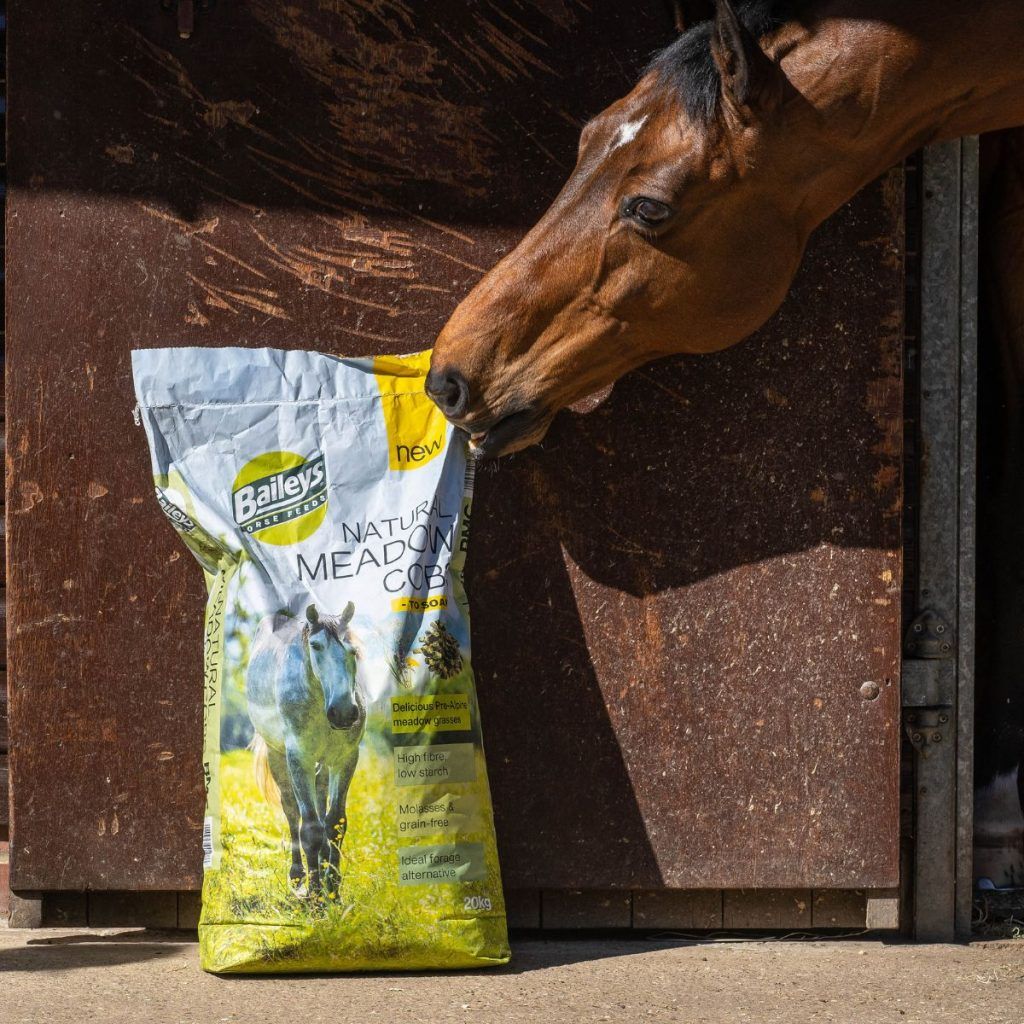
- Soaked Speedi-Beet or Natural Meadow Cobs, given in a separate bucket from any short feed, and are both low in calories.
- Boredom balls, containing “considered” quantities of low calorie treats like Fibre Plus Nuggets, Natural Meadow Cobs, high fibre cubes or even the horse’s daily amount of balancer.
- Feeding straw to replace up to a maximum of 30% - 50% of the forage ration. It is high in fibre but low in calories and cab be mixed with pre-soaked hay or fed wet, to help maintain moisture intake and reduce the risk of gut impactions.
- “Liven up” your haynets by incorporating small amounts of cow parsley or hawthorn. Make sure you are accurately identifying these plants and not feeding anything poisonous.
- Other methods of stable enrichment to reduce boredom, like scratching boards, mirrors or, where possible, creating a smaller yard area, outside the stable, for them to wander in and out.
Always introduce new fibre sources gradually. If your horse is still getting through their forage very quickly, and you’ve tried everything you can to slow them down, you may need to increase the amount of forage fed very slightly so that they are not spending long periods with nothing to eat.
Next up is Working out how much forage to feed
Want to read more?
Ready to take the next step?