
Work out how much forage to feed

Oct 8
Expert Advice from Baileys Horse Feeds, Official Feed Partner to British Eventing 

Although an ‘ad lib’ forage provision is the ideal for supporting gut health, as long as it is done sensibly, limiting long periods without forage access to no longer than 4 hours, reducing the amount of forage provided is a good next step to take, especially if soaking the hay and/or using a later cut forage is still not deemed sufficient, or if these options are not possible at your yard. 


Here we show you how to work out the minimum amount of forage/fibre to feed, in total. If your horse or pony is grazing for part of the day, you may need to account for this by reducing the amount of forage fed accordingly. We would recommend discussing this with a nutritionist to ensure minimum fibre intake requirements are met. 

Calculate minimum forage requirements 
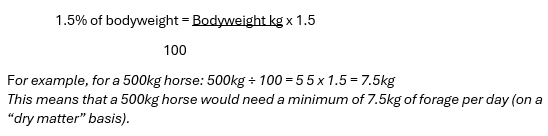
  • A horse or pony should receive a minimum of the equivalent of 1.5% of bodyweight, or 1.5kg per 100kg of their bodyweight, in forage per day, on a “dry matter” basis. Since hay and haylage both contain some moisture (water) – with haylage containing a greater proportion, on average, than hay - we need to account for that when working out how much actual hay or haylage to feed ie. “fresh matter”. 
  • Horses who get turned out will obtain a proportion of their daily fibre from grass but, if they are mostly stabled, or are turned out on a very bare paddock, the following calculation will indicate the minimum amount of supplementary forage you will need to provide.  

How much hay/haylage to feed 
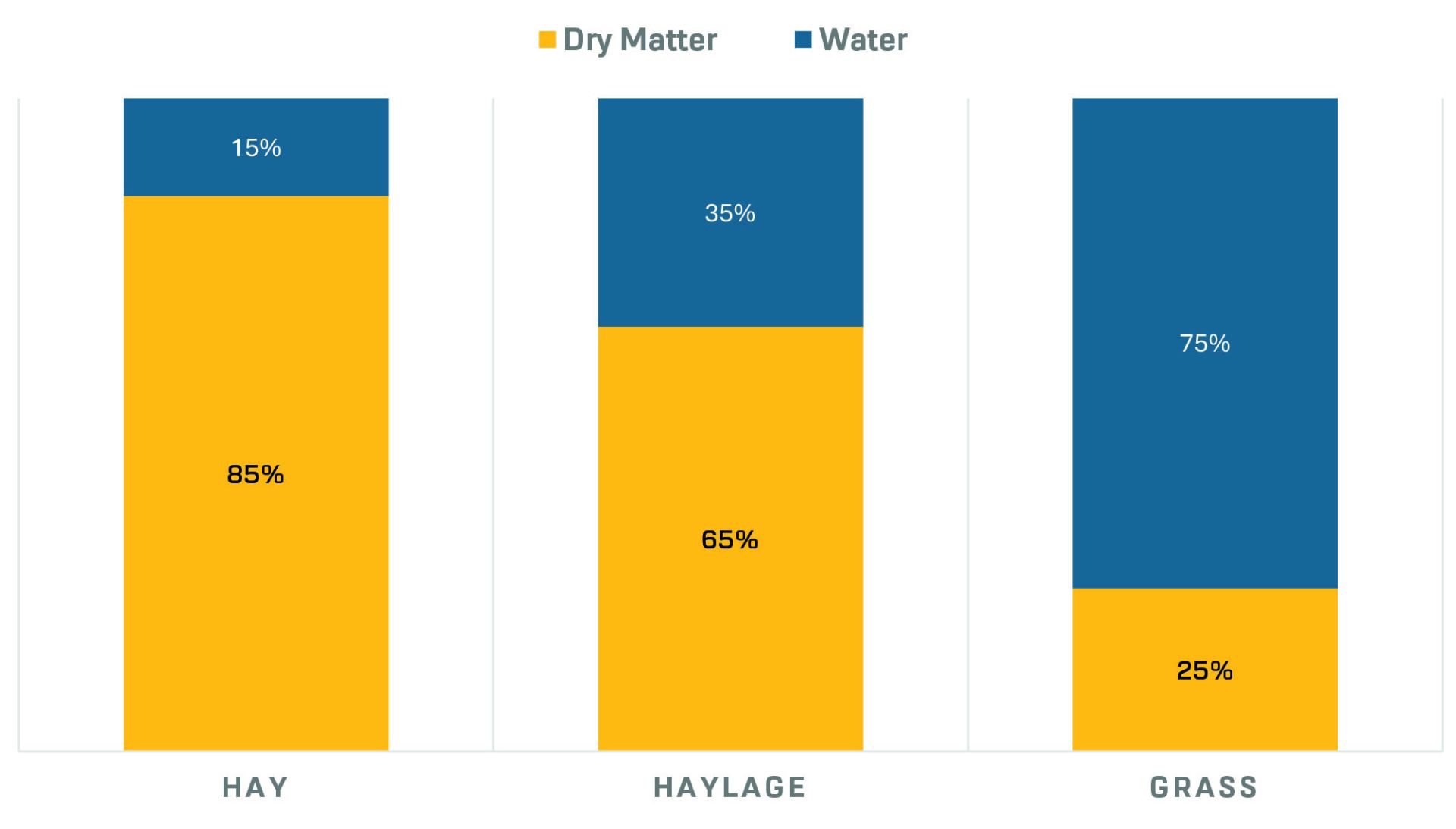
Next we must account for the fact that all forages contain a percentage of water. Although hay usually feels quite dry, it still typically contains a moisture (water) content of around 15%, while haylage is generally wetter to the touch and can have a moisture content of 25-40%. 

This means that 7.5kg of hay might contain 1.1kg of water, leaving only 6.4kg of dry matter/fibre, and 7.5kg of haylage may contain up to 2.6kg of water, with only 4.9kg of dry matter/fibre. 

If we assume that hay has an average moisture content of 15% ie. is 85% dry matter, and haylage has an average moisture content of 35% ie. is 65% dry matter (figures are based on average dry matter levels but may vary for different forage), we can use these figures to calculate how much forage to weigh out(“fresh matter”) to give the required “dry matter”.  

Ever wondered what stretches to do?

You'll be there new best friend - it involves carrots!

Understanding Fatigue

Prioritising your horse, even the best-conditioned horses can experience fatigue

Do you wonder how horses learn?

No need, we have the answer- learn from Gemma Pearson.

Weight of “fresh” hay required kg = dry matter figure from above eg. 7.5 ÷ 0.85 = 8.8kg 


0.85 

Weight of “fresh” haylage required kg = dry matter figure from above eg. 7.25 ÷ 0.65 = 11.5kg 

0.65 
Although it looks like you would be feeding a lot more haylage than hay, this is just to account for the extra water weight in haylage, and the actual dry matter intake for your horse will still be roughly the same!  

  • The calculations above will provide you with a guideline for the minimum amount of forage required, but they are only an estimate so, if grass cover in your fields is more limited or if the haylage is particularly wet, you may need to feed slightly more to ensure that requirements are still being met.  
  • To weigh out your forage, fill a haynet and use a spring scale or luggage scale to hook onto the net to weigh how much it holds. If you use large or heavily knotted nets, it might be worth weighing them empty and account for this when weighing your forage. Be as accurate as you can, when weighing, as going over their requirement by even 100-500g each time will all add up!  
  • It is best to weigh your horse’s total hay or haylage ration for the day and then divide it up into as many smaller portions, to be fed throughout the day, as possible. 
  • Reduce hay intake slowly, rather than suddenly reducing it from being fed fully to nothing.
Next up is Grazing

Ready to take the next step?

Whether you're preparing for your first event or looking to build on your experience, BE Prepared gives you free access to expert coaching videos, practical guides, downloadable checklists and event-day advice to help you train smarter and compete with confidence.