
Hard Feed
Oct 8
Expert Advice from Baileys Horse Feeds, Official Feed Partner to British Eventing
Research, and our extensive database of forage and pasture analyses, reveal that modern grazing and hay/haylage are often lacking in key nutrients, particularly minerals, while protein levels are also unreliable. Couple this with soaking hay to leach out calories – which also takes other nutrients with it – plus turnout which may have been poached or heavily grazed, and it’s clear that even the plumpest equine needs some form of supplementary feeding.
A balanced diet is important for all horses to support overall health and wellbeing, including a healthy metabolism for weight loss, good energy levels, and muscle tone and top line. What you feed should be designed to provide what is lacking in forage, namely vitamins, minerals and good quality protein, all of which can be provided by the recommended amount of a good quality low calorie balancer.
Nutrients without calories
Whilst feeding small ‘token’ amounts of a low energy high fibre mix or cube may not provide many calories, these feeds are usually formulated to be fed at much higher levels, by the scoop full, to ensure a balanced diet. For example, a 500kg horse in light work would typically require approximately 1 ½ Stubbs scoops a day, of cubes, or 2 Stubbs scoops a day, of mix. Feeding less than the recommended quantities, to control calorie intake, means that your horse will be missing out on nutrients they need, but still getting some calories that they don’t!
This is why low calorie balancers are so useful as they are concentrated and much more nutrient-dense than more traditional mixes or cubes so the feeding rates are therefore much smaller, at 100g per 100kg of bodyweight. This means that a typical 500kg horse in light work would need just 2 coffee mugs (500g) per day, all year round. To provide a balanced diet using a “low energy” basic high fibre cube, you would typically need to feed around five times as much volume, compared to a balancer – which would also supply more megajoules for weight gain, as shown in the chart below
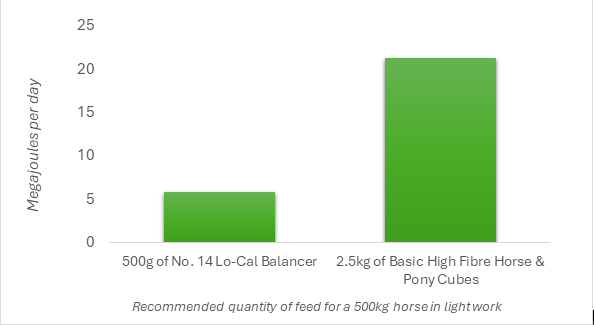
Feeding half a scoop of cubes may provide similar calorie/energy levels to two mugs of balancer, but the nutrient contribution will be significantly lower. The charts below show just how much of a drop in some of the key nutrients will be provided if feeding just half a Stubbs scoop of a basic high fibre cube, compared to two mugs a day (500g) of No. 14 Lo-Cal Balancer.
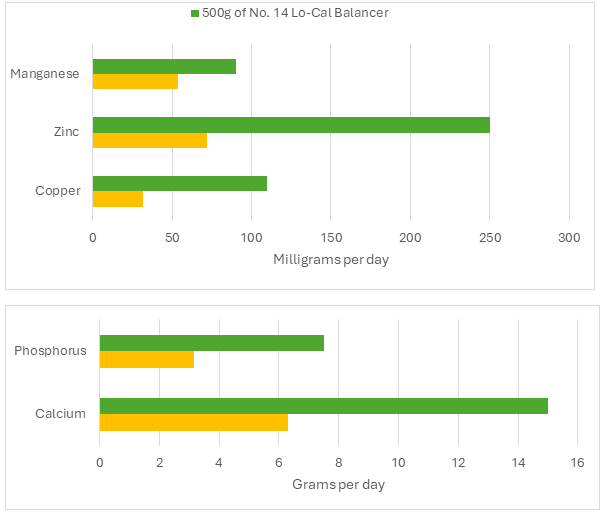
Feeding the correct amount of a Baileys pelleted balancer will supply your horse with good levels of key nutrients for a balanced diet whilst keeping calorie intake to an absolute minimum.
Ever wondered what stretches to do?
You'll be there new best friend - it involves carrots!
Understanding Fatigue
Prioritising your horse, even the best-conditioned horses can experience fatigue
Do you wonder how horses learn?
No need, we have the answer- learn from Gemma Pearson.
All about Baileys’ balancers…
They’re all:
- Low calorie
- Low starch
- Low sugar
- Low energy
- Non-heating
- Fully balanced with vitamins, minerals and quality protein
- Fed by the coffee mug (100g per 100kg of bodyweight - typically 1-3 mugs per day for mature working horses)
They’re ideal for:
- All good-doers!
- Stressy/excitable types
- Those prone to laminitis
- Those prone to gastric ulcers
- Any horse needing a low starch diet, e.g., due to a clinical condition
They help:
- Encourage overall health in those needing a low-calorie diet
- Promote top line and muscle tone
- Healthy hoof growth, by providing nutrients like biotin, methionine, calcium and zinc
- Give peace of mind that, no matter how poor, or limited, a horse’s forage intake is, they’ll always get their essential vitamins, minerals and quality protein
Choose your feed balancer
At rest/light work: No. 14 Lo-Cal Balancer
The low-calorie balancer for those who get fat on thin air!
- Protein 16%
- Starch 6%
- Sugar 5.5%
- Oil 4.5%
- Fibre 12%
- Biotin 30mg/kg
Moderate/hard work: No. 19 Performance Balancer:
Higher levels of quality protein, nutrients and antioxidants for those in moderate to hard work, whilst still remaining low in calories.
- Protein 26%
- Starch 6%
- Sugar 6.5%
- Oil 7%
- Fibre 7.5%
- Biotin 30mg/kg
Broodmare/youngster: Stud Balancer:
For broodmares, foals and youngstock to promote steady, even growth without calories.
- Protein 32%
- Starch 6.5%
- Sugar 7.5%
- Oil 5.5%
- Fibre 5%
- Biotin 30mg/kg
A free Baileys measuring mug should be available from your local feed merchant, but, if not, you can request one by emailing nutrition@baileyshorsefeeds.co.uk.
Extra fibre sources
Once you have selected a suitable balancer for your horse’s level of work, you may wish to add an extra fibre source, to increase chew time, or make your horse feel like he is getting a little more from his bucket feed. Suitable choices include:
Light Chaff: This is a low-calorie chaff containing alfalfa and oat straw, with a tasty dusting of mint. It can also be fed in a separate bucket in larger quantities to make up a proportion of your horse’s fibre provision, as it is lower in calories than many hays/haylages. If you do feed it this way, be sure to recalculate how much forage you feed, to take the Light Chaff into account.
Speedi-Beet: This unmolassed beet is very low in sugar and, because it absorbs a great deal of water and becomes quite ‘fluffy’ upon soaking, the calorie content of a soaked scoop is relatively low. For example, one coffee mug of dry Speedi-Beet swells up to approximately one large round Stubbs scoop, once it has been soaked! Even though the volume will look a lot to your horse, the calories remain minimal.
Natural Meadow Cobs: These are harvested when the grasses are mature and stalky so are high in fibre, including the less calorific types of fibre, and low in calories. When soaked they smell delicious, swell to a large volume and the coarser fibres really keep horses chewing, while still being low in calories.
“Happy”, “Healthy” Diet Feeds
There are many fibre-based “diet” feeds available for good-doers and these are a popular choice, however they are designed to be fed in what look like reasonably large volumes to provide a balanced diet so many end up being underfed. This may seem appropriate, to help control calorie intake, but feeding rates are calculated to provide a balanced diet, supplying essential protein, vitamins and minerals, as well as low calorie fibre, so the horse will be missing out.
Therefore, when feeding a “fortified” or “complete” low calorie chaff or fibre product, check the feeding recommendations and feed according to your horse or pony’s bodyweight and workload. The full amount will take some chewing and you will also need to account for the fibre provided by subtracting the weight fed from the forage ration to ensure calorie intake remains in check.
Feeding the recommended amount of a low calorie balancer, with a low calorie chaff or soaked fibre product, gives you peace of mind that your horse or pony is getting a fully balanced diet, every day, while you have the flexibility to vary the fibre intake to suit.
Livening up a lazy horse
Improving energy levels in the overweight horse can be particularly difficult, as ‘calories’ are simply a unit of energy, therefore a “high energy” feed will also be high in calories, which if not burned during exercise, will go to the waistline. However, there are a couple of dietary points we can consider when aiming to improve energy levels, while weight loss itself will also be a big help!
- Ensure the diet is balanced -> Just like people, if horses don’t get all their essential vitamins, minerals and protein, they may feel a little lethargic! Making sure their diet is balanced is a great first step in improving energy levels, as they will then be getting everything that they need to support their workload. This means giving them the full recommended amount of a compound feed or balancer, but, if you’re not sure, talk to your Baileys Feed Advisor who will help you formulate a fully balanced diet for your horse.
- Consider hydration status -> If body salts, lost through sweating, are not replaced adequately, a horse takes longer to recover from exertion may feel fatigued. Loss of electrolytes (body salts) is directly proportional to the amount a horse sweats therefore, if a horse is sweating a lot on a regular basis, giving an electrolyte supplement, like Baileys Aqua-Aide, either in water or wet sloppy mash or feed, will help replace lost salts and encourage rehydration.
- Add a small amount of oats -> If you are still struggling, the next step would be to try using some straight oats. In spite of sometimes negative press, oats are a useful source of ‘fast-release’ energy and quantities can be adjusted depending on energy requirements. This means that we will not be adding excessive calories into the diet when they are not required. Start with a very small handful of oats, on a daily basis, to allow the digestive system time to adapt to them, then increase them slowly. The slower you are able to increase the amount of oats in the diet, the easier it will be to pinpoint the exact point when you have enough and not too much energy. Once you have found the amount of oats that provide the desired enthusiasm, remember this amount and you can increase or decrease as needed for harder working sessions or competitions.
I haven’t got time for all this!
There’s no doubt about it, managing our horses to support healthy weight loss definitely takes time so, if you can’t do everything straight away, do what you can – a few simple changes to support weight loss will be better than nothing:
- You could start by limiting turnout time then looking at your bucket feed and switching to a balancer to reduce calorie intake. Monitoring your horse’s progress using body condition scoring and taking regular photos will help you to identify if these changes are working.
- Ask around at the yard to see if there is anyone who can help you out, perhaps by bringing your horse in early or popping some hay in to soak before you arrive.
- If you can afford to do so, pay someone to help out with the basic yard chores, giving you more time to focus on your horse’s weight management and exercise.
- If you struggle to find the time to ride your horse very often, consider getting a sharer to help.
- On the days that you don’t have time to tack up and go for a proper ride, consider lunging or even walking in hand for a shorter period – just to get them moving each day!

NEWSLETTER
Thank you!

BE Prepared is an initiative of the British Eventing Training Foundation
Copyright British Eventing Ltd & the British Eventing Training Foundation
© 2026
© 2026
Write your awesome label here.
Don't forget a thing!
Heading to an event? Don’t forget a thing! Take our checklist with you and be prepared for your next event.
Thank you!