
Providing a balanced diet should be a priority when managing hoof health.
The formation of the structural proteins of the hoof horn is dependent on an appropriate supply of amino acids, vitamins and minerals and, although a good balance within the diet is essential, to support the body as a whole, there are a couple of nutrients which play a greater role than others, in hoof health in particular.
Biotin: Also known as Vitamin B7, biotin is involved in carbohydrate, protein and fat metabolism and is just one of the nutrients required to support hoof health. Horses’ microbiomes produce B vitamins, including biotin, in the large intestine and combining these with the biotin received from a balanced concentrate ration, usually provides adequate levels for the horse.
Calcium: As a key macro-mineral in bone development and structure within the body, calcium is also responsible for assisting with the linkages between hoof proteins which help to improve cell cohesion and hoof strength.
Zinc: This mineral assists in carbohydrate and protein metabolism and is also a component of an enzyme responsible for collagen synthesis. It is also important in the correct formation of keratin, which is the tough structural protein in the hoof wall. Defective keratin can cause the hoof to be weakened.
Protein: This is an essential nutrient which is vital for healthy hoof formation. As well as the level of protein within the diet, its quality ie. amino acid profile, should also be considered. The amino acid, methionine, in particular, is important in the formation of keratin so a shortfall of quality protein in the diet may result in poor hoof health.
The formation of the structural proteins of the hoof horn is dependent on an appropriate supply of amino acids, vitamins and minerals and, although a good balance within the diet is essential, to support the body as a whole, there are a couple of nutrients which play a greater role than others, in hoof health in particular.
Biotin: Also known as Vitamin B7, biotin is involved in carbohydrate, protein and fat metabolism and is just one of the nutrients required to support hoof health. Horses’ microbiomes produce B vitamins, including biotin, in the large intestine and combining these with the biotin received from a balanced concentrate ration, usually provides adequate levels for the horse.
Calcium: As a key macro-mineral in bone development and structure within the body, calcium is also responsible for assisting with the linkages between hoof proteins which help to improve cell cohesion and hoof strength.
Zinc: This mineral assists in carbohydrate and protein metabolism and is also a component of an enzyme responsible for collagen synthesis. It is also important in the correct formation of keratin, which is the tough structural protein in the hoof wall. Defective keratin can cause the hoof to be weakened.
Protein: This is an essential nutrient which is vital for healthy hoof formation. As well as the level of protein within the diet, its quality ie. amino acid profile, should also be considered. The amino acid, methionine, in particular, is important in the formation of keratin so a shortfall of quality protein in the diet may result in poor hoof health.
Year-round nutrition
Since horn can take 6 to 12 months to grow down from the coronary band, it’s important to ensure the horse’s diet is fully balanced all year round as the nutrients a horse is consuming during the summer, for example, will be part of the hooves it will be working on through the winter! It’s now widely recognised that modern pastures and forages are deficient in protein and key minerals so, while they may meet a horse’s calorie requirements, they cannot be relied upon to provide all the nutrients required for well-being and healthy hoof growth.
For example, Baileys’ extensive pasture and forage analyses show that grass is likely to be deficient in zinc and copper, resulting in a shortfall of 33 and 39% of a horse’s daily requirements*, respectively. Hay and haylage may supply only 42% of a horse’s daily zinc requirements and as little as 25% of their daily copper requirements. This highlights the need to supplement all forages with the recommended amount of a mix, cube or balancer, according to body condition and workload, to ensure a fully balanced diet.
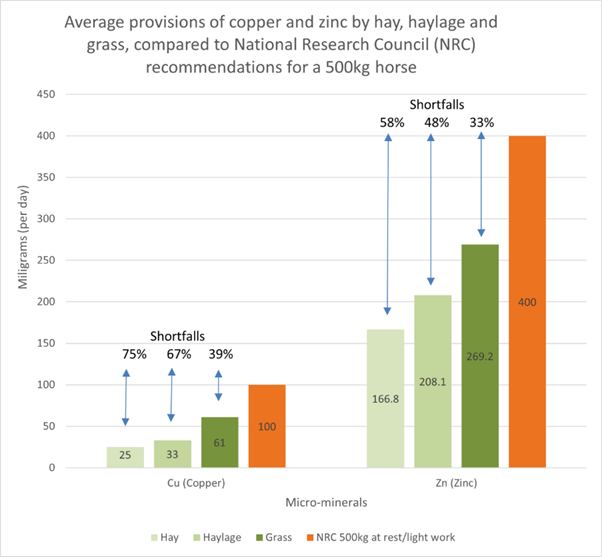
*National Research Council (NRC) – Nutrient Requirements for horses. Industry recognised minimum daily requirements of horse’s micronutrients.**The graph references a 500kg horse in rest/light work fed either as the sole forage, at a rate of 2% of bodyweight ie. 10kg on a dry matter basis.
Do I need a supplement?
Feeding the recommended amount of a good quality mix, cube or balancer, according to bodyweight, condition and workload, alongside healthy levels of forage, should provide all the nutrients a horse needs for healthy hoof growth. If feeding a good quality balanced diet, for at least 9 months, does not achieve the desired results, it could be indicative of an issue with the absorption and utilisation of the nutrients which may be remedied with additional supplementation.
This could mean increasing feeding rates of the current feed or, when no additional calories are required, topping up the diet with a balancer to increase protein, vitamin and mineral levels without adding to the waistline. Should a hoof supplement be deemed more appropriate, it should contain the full range of hoof nutrients though, and not just biotin. Don’t forget the influence of the environment on hoof integrity either, as constant wet conditions and/or wet then dry conditions, can take their toll on even the best nourished hooves.
Baileys Balancers for Strong Healthy Hooves
Both Lo-Cal and Performance Balancer provide the full spectrum of essential nutrients to support healthy hoof growth, particularly those known to be lacking in pasture and forage. Being low in calories, they are ideal for those whose calorie requirements are met by forage or grazing alone, especially those on soaked forage or poor or restricted grazing, whose nutrient intake is all the more limited.
Both Lo-Cal and Performance Balancer provide the full spectrum of essential nutrients to support healthy hoof growth, particularly those known to be lacking in pasture and forage. Being low in calories, they are ideal for those whose calorie requirements are met by forage or grazing alone, especially those on soaked forage or poor or restricted grazing, whose nutrient intake is all the more limited.
Want to read more?
Ready to take the next step?