Effective parasite control in adult horses

Sep 23
Keep your horse healthy while helping to protect the wormers we rely on with a targeted, test-led approach to parasite control.
Worm control has changed. Regularly worming every horse at fixed points throughout the year is no longer considered best practice for mature horses – and may ultimately put them at higher risk of disease. Instead, current advice is to assess each horse's risk, use appropriate diagnostic tests and only treat when there is a good reason to do so. And to focus hard on reducing grazing horses’ risk of acquiring worms in the first place, for example: if people practice good pasture management (especially regular poo picking) then they will be going a long way to winning the battle of worm transmission, It’s also worth being mindful of where your horse grazes away from home, such as at events, as unfamiliar pasture may expose them to parasites, including potentially resistant parasites.

This matters not only for your horse's health, but for the future of parasite control. Resistance has now been reported to all classes of wormer currently available in the UK, and there are no new classes waiting in the wings. Using wormers only when they are genuinely needed helps preserve their effectiveness.

TEST, DON'T GUESS

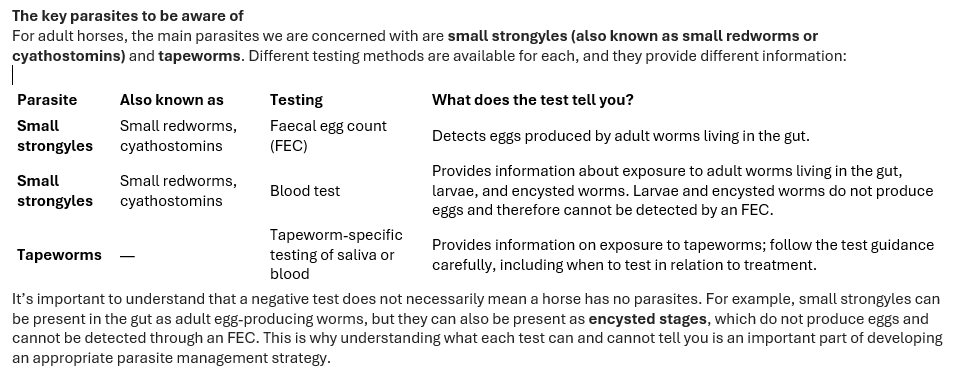
Faecal worm egg counts (FECs) are an important part of a modern parasite-control programme. A small sample of fresh droppings is sent to a laboratory, which measures the number of parasite eggs being shed and reports the result as eggs per gram (epg). However, please be aware that FECs don’t reliably detect tapeworms.

Regular FECs should be carried out while horses are grazing, with the frequency determined by the horse's individual risk, previous results and management. However, as every yard’s situation is different, it’s important to work with your vet to develop an appropriate parasite management and testing strategy, including how frequently testing should be carried out.

However, a low worm egg count doesn't mean your horse is completely worm-free. FECs measure egg shedding rather than the horse's total worm burden, and they cannot reliably detect every parasite or life stage. In particular, they cannot tell you whether a horse has a significant burden of encysted small redworm larvae.

For mature horses without signs of disease, a treatment threshold of more than 200–500 epg is commonly used. In low- to medium-risk adult populations, the higher threshold of more than 500 epg may be appropriate. Results should always be interpreted alongside the individual horse's age, health, history and management. Again please consider discussing with your vet the results.
WHAT ABOUT TAPEWORM?

Rather than automatically treating for tapeworm once or twice a year, current advice for mature horses is to test first and treat where results indicate significant exposure.

Saliva and blood tests can measure antibodies against tapeworm. These indicate exposure rather than directly detecting living worms, so results need to be interpreted appropriately. Check the package insert for the test’s specific guidance, as testing too soon after treatment for tapeworm may result in uninterpretable results.

For many well-managed adult horses, testing once a year is a reasonable starting point, although horses at greater risk may benefit from more regular testing.

ENCYSTED REDWORM: DOES EVERY HORSE NEED A WINTER WORMER?

Not necessarily.

Historically, owners were commonly advised to give every horse a larvicidal treatment during autumn or winter to target encysted small redworm. Current guidance for mature horses is more targeted. And remember, FECs won't tell you re encysted cyathostomin levels.

The risk of disease caused by encysted small redworm should be considered alongside the horse's age, management, previous worm egg counts and treatment history. Routine larvicidal treatment is now discouraged in mature horses that repeatedly have low FEC results and are managed in a way that puts them at low risk.

A blood test for small redworm exposure is also available, but current guidance is that it should not routinely be used on its own to decide whether to treat. Speak to your vet about the most appropriate approach for your horse.

DID THE WORMER WORK?

Resistance means we can no longer assume that giving a wormer has successfully treated the parasites present.

Where treatment has been necessary, a faecal egg count reduction test (FECRT) can help assess whether the wormer has worked effectively. This involves carrying out another FEC approximately 10–14 days after treatment.

Where horses on a premises require worming, checking treatment efficacy annually can help identify emerging resistance and guide future parasite-control decisions.


Ever wondered what stretches to do?

You'll be there new best friend - it involves carrots!

Understanding Fatigue

Prioritising your horse, even the best-conditioned horses can experience fatigue

Do you wonder how horses learn?

No need, we have the answer- learn from Gemma Pearson.

10 WAYS TO REDUCE PARASITE RISK AND PROTECT OUR WORMERS

1. Test before you treat

Build your horse's parasite-control programme around risk assessment and diagnostic testing rather than automatically worming at fixed intervals.

2. Seek expert advice

Your vet or suitably qualified person (SQP) can help you interpret results and choose an appropriate treatment when one is required.

3. Dose accurately

Know your horse's weight as accurately as possible and give the correct dose. Both underdosing and unnecessary overdosing should be avoided.

4. Poo-pick regularly

Removing droppings from grazing is one of the most effective non-drug methods of reducing pasture contamination. Aim to poo-pick at least twice a week and more frequently during warmer conditions.

5. Avoid overcrowding

Lower stocking densities and good pasture management can reduce horses' exposure to infective parasite larvae.

6. Manage grazing carefully

Resting and rotating grazing and, where appropriate, co-grazing with other species such as sheep or cattle can help reduce parasite challenge. Routine harrowing of contaminated grazing isn't recommended as a parasite-control strategy because it will spread infective larvae around the pasture.

7. Have a plan for new arrivals

Assess, test and, where appropriate, treat new horses before integrating them into the resident grazing group. Seek veterinary advice when developing a quarantine protocol.

8. Monitor whether treatment works

Don't assume a wormer has been effective. Post-treatment FECs can identify reduced efficacy and detect resistance.

9. Protect wildlife and waterways

Wormers don't only affect worms. Residues can harm dung beetles and other beneficial invertebrates and may contaminate aquatic environments. Keep muck heaps away from watercourses, ponds and drains and dispose of wormer packaging responsibly.

10. Think beyond wormers

Good pasture hygiene, sensible stocking densities, appropriate grazing management, diagnostic testing and keeping accurate records should form the foundation of parasite control. Wormers are just one tool within the programme.

AFTER WORMING

If your horse does need treatment, consider what happens to the drug afterwards.

Wormer residues are excreted in droppings and can affect insects and other wildlife. Current BEVA guidance recommends keeping treated horses stabled or removing their droppings from pasture every day for around seven to eight days after most treatments. If products containing moxidectin, such as Equest or Equest Pramox, are used, droppings should be removed daily for 12–14 days.

Dung containing wormer residues should be stored on a muck heap for at least six months before being spread on land, and muck heaps should be positioned well away from watercourses, ponds and drains.

THE MODERN APPROACH

The aim of parasite control isn't to eliminate every worm from every horse. Maintaining a population of worms that hasn't been exposed to wormers — known as refugia — is actually an important part of slowing the development of resistance.

Instead, the goal is to prevent parasite-related disease, reduce excessive contamination of pasture and use wormers selectively enough that they remain effective when horses genuinely need them.

A good parasite-control programme therefore combines:
Risk assessment + diagnostic testing + good pasture management + targeted treatment + monitoring treatment effectiveness.

Every yard and every horse is different, so work with your vet or SQP to develop a programme appropriate for your horse's age, health, management and grazing environment.

This advice relates primarily to healthy mature horses. Foals and young horses under five require different parasite-control considerations and should have an age- and risk-appropriate programme developed with veterinary guidance.

For more information please see the CANTER guidelines here: https://canterforhorses.org.uk/guidelines/

Ready to take the next step?

Whether you're preparing for your first event or looking to build on your experience, BE Prepared gives you free access to expert coaching videos, practical guides, downloadable checklists and event-day advice to help you train smarter and compete with confidence.