
Getting your horse fit to event
Foundations of fitness
1. The fitness pyramid
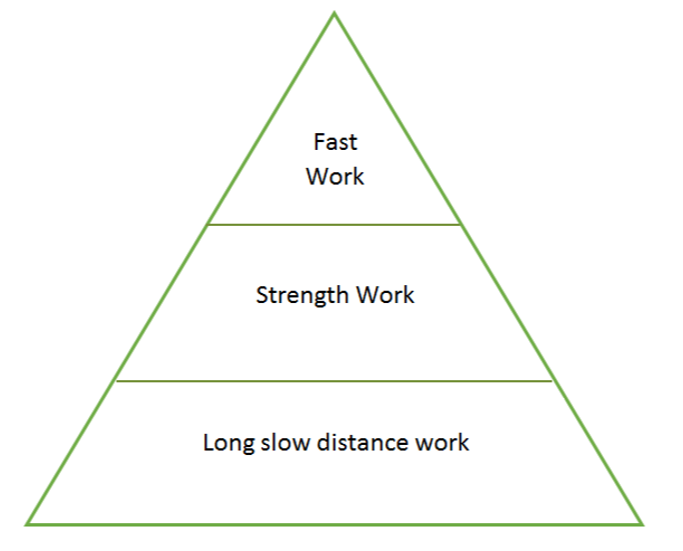
- Only introduce one variation to change the horse’s
‘volume of work’ at a time, and allow the horse to adapt to that before adding
another variation.
- Step up duration, frequency or intensity of the work, but then maintain that work load until the horse has ‘adapted’ to it before stepping up again. This means you do not suddenly introduce a longer, faster, hillier ride, but gradually make his training more regular, or longer, or faster, or on more challenging terrain.
2. Volume of work = distance/duration x frequency x intensity
If a horse performs the same volume of work every week, it will maintain fitness but won’t improve in fitness. Increasing the frequency of training will improve strength and in schooling work also develop skill and suppleness. Increasing duration or intensity (intensity being that which increases the horse’s heart rate) in a workout will improve cardiovascular fitness.
Using key events as ‘goals’, build towards these by creating an ideal ‘work’
diary for each horse that is relevant to his breed and temperament. Alongside
this, chart his actual workload to inform his fitness training plan for the
future. Getting a horse to peak fitness is regarded as being hardest the
first time, but their physiological memory, and your understanding of what
benefits him best, or what he struggles to adapt to most, makes it easier for
subsequent seasons.
3. Fitness for your first BE event
Developing a young horse over the period of up to 12 months, or a specific four- to eight-week programme when returning a horse to work, will have achieved the ‘long, slow, distance’ base fitness level. This means the horse has built up fitness to easily cope with a 45-60 minute hack at walk, trot and canter, sustaining periods of canter for two to three minutes, five or six times a week.
Swap in two or three shorter ‘strength’ training sessions a week, such as gymnastic jumping, riding up and down hills and suppling/dressage sessions and your horse will be fit for a grassroots, one day event.
At your horse’s first event, you may well be in the saddle longer than he is used to, with perhaps a 45 minute dressage warm-up, 20 minute show jumping warm-up and 15 minute cross country warm-up. Practice spending longer in the saddle by doing a 20 minute schooling session when you’ve returned from your hack or take part in combined training competitions to help the horse get used to being warmed up and worked more than once – and in more than one discipline – in one day.
Preparing for a longer cross country course
If you are looking to compete over a longer cross country course than your horse is used to. This is the point where you now need to introduce specific fast work into your training. After a 20 minute warm-up, it’s ‘intervals’ that then really build the fitness. Interval training then progresses over the weeks by increasing speed, distance, duration, the number of repetitions, or by decreasing the amount of recovery time, followed by another 20 minute cool down.
The step from BE100 to Novice is the most challenging in developing your horse’s fitness. The horse needs to blow to get fitter, so some people without access to a suitable place to gallop will use hill work instead. Take advice from coaches, but given the layout of gallops it’s normally the speed the horse is ridden at and the number of repetitions ‘up’ the gallops that is used to progress the horse’s fast work. For instance, for the gallops I use and the recovery time it takes to walk back to the start, I know twice up is sufficient for their first International, but five times would be needed for a CCI5* horse. How quickly the horse recovers is the best indicator of fitness, and for this reason some riders use heart rate monitors, too.
Topography
The horse will always opt for the most energy efficient option, choosing to canter up a steep hill rather than walk or trot. Trotting up steep hills is less favoured as this can increase the risk of sacroiliac strain but walking up a hill while leg yielding left and right is surprisingly beneficial, helping activate the horse’s core while walking downhill can help a horse to learn to ‘sit’ on his hindquarters.
You need to learn to canter downhill, and uphill, in balance and on a line, before you add a jump into the mix too! It is important not to let your horse run too fast downhill, leading to a fight to bring him back, risking at the very least time faults or fatigue and injury. Similarly, you should not push a horse uphill, but have sufficient fitness that he can cruise up it.
The process of ‘supercompensation’ – where the horse can actually increase fitness with a drop down or break in training – means that a few days’ holiday every six weeks or so is actually advantageous. It is understood that up to four weeks of no exercise does not reduce the cardiovascular fitness of a horse, but their ‘strength’ fitness does decrease. After four weeks off, a couple of weeks of long, slow, distance training is required to prepare the horse before adding any strength work, such as jumping or hill work. For a horse who has had time off through injury, following a veterinary prescription to rehabilitate them is important.
Following injury, time is the biggest healer. It is really important that this bit is not rushed. In terms of preventing injury, you never regret withdrawing. BE works very hard to set standards, but be realistic about the suitability of the conditions in both the warm-up and in the competition areas for your horse and his fitness. If your horse is sensitive to hard ground, choose events with warm-up/competition areas on a surface, or cut down your time in the warm-up arenas. If your horse is tired he is at greater risk of injury or accident, so pull up and learn from it.

NEWSLETTER

BE Prepared is an initiative of the British Eventing Training Foundation
© 2026